

- Filter by category
- Emerging trends
- From Fellows & Practitioners
- From the founder
- Strategic Doing in complex systems
- Supporting theories
- Collaboration, trust, and psychological safety
- Complexity, emergence, and limits of planning
- Design, visuals, and sensemaking
- Inquiry, framing, and powerful questions
- Leadership, guiding teams, and distributed action
- Networks, systems, and collective intelligence
The Complexity Era in Economics
The paper shows current research that underpins the Strategic Doing methodology in dealing with complex problems and why old models of approaching issues are no longer relevant to current attitudes and needs
Connected: The Surprising Power of Our Social Networks
Explores how social networks shape behaviour, influence, and outcomes.
Guiding Cross-Disciplinary Teams
Outlines practices that support boundary-spanning collaboration.
Linked: How Everything Is Connected to Everything Else
An accessible exploration of network theory and systemic interdependence.
The World Is Flat: A Brief History of the Twenty-First Century
Explores global interconnectedness and the rise of networked, cross-boundary collaboration.
Corporate Languages and Strategic Agility
Shows how informal language and everyday conversations shape an organisation’s ability to adapt.
Your Organization Is a Network of Conversations
Argues that strategy and coordination emerge through conversations rather than formal structures.
Network dynamics of social influence in the wisdom of crowds
Examines when and why groups outperform individuals, highlighting the role of equity and interaction design.
Peer Feedback Loops: Why Meetings and Metrics Are Not Enough
Describes how structured peer feedback and reflective space enable learning and alignment beyond traditional performance mechanisms.
The Essentials of Appreciative Inquiry
Examines how carefully crafted questions shape attention, behaviour, and outcomes in organisations and communities.
Collaborative Networks: a mechanism for enterprise agility and resilience
A scholarly paper explaining why collaborative networks outperform hierarchical structures in volatile environments, providing theoretical grounding for Strategic Doing’s network-based approach.
A visual example of the problem with vision statements
A TED talk that uses humour and design failures to show why poorly framed vision statements confuse rather than align, reinforcing the importance of clarity and shared meaning.
Understanding Culture Through Pictures and a Thousand Words
Demonstrates how visual methods support sensemaking and shared understanding in complex cultural settings.
Positioning Wicked Problems Along Two Dimensions
A visual framework helping distinguish problem complexity and collaboration intensity.
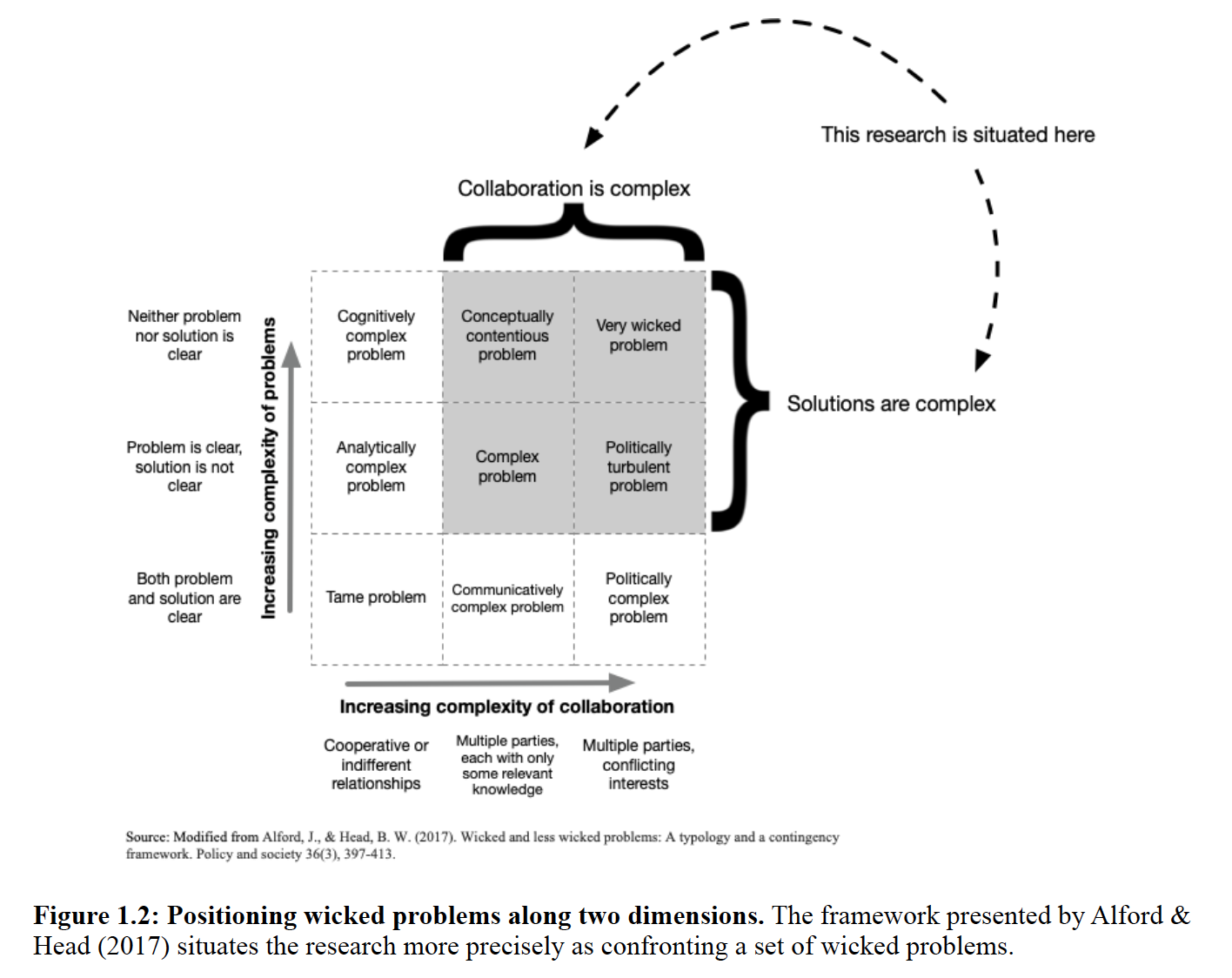
Psychological Safety
Explains why trust and inquiry are essential for effective teamwork and learning.
Psychological Safety: A Meta-Analytic Review and Extension
A comprehensive review showing how psychological safety affects learning, performance, and collaboration.
Simple Rules, Complex Behavior
Explains how simple guiding rules enable complex, adaptive behaviour.
Teams Solve Problems Faster When They’re More Cognitively Diverse
Demonstrates the performance benefits of cognitive diversity when collaboration is intentionally designed.
An Effectual Model of Collective Action for Addressing Sustainability Challenges
Presents a model for collective action under uncertainty, integrating effectuation theory with Strategic Doing.
Distributed Leadership as a Sustainable and Inclusive Leadership Approach
Provides a framework for understanding leadership as a shared, relational practice.
How do I implement complex change at scale?
Addresses the challenges of scaling change in complex systems, aligning closely with Strategic Doing’s iterative approach.
Got a wicked problem? First, tell me how you make toast
Illustrates how hidden assumptions undermine collaboration and why shared framing is essential in complex problem-solving.
Where Good Ideas Come From
Explains how innovation emerges from loosely connected interactions over time, reinforcing Strategic Doing’s emphasis on networks.
Why good leaders make you feel safe
Explores how trust, care, and psychological safety enable learning, performance, and long-term organisational resilience.
Levels of Appreciative Inquiry
Uses experiences from COVID-era collaboration to illustrate how inquiry operates across multiple system levels.
Strategic Doing: A New Discipline for Developing Strategy
This paper introduces Strategic Doing as a network-based strategy discipline designed for open, loosely connected systems. It explains how simple rules and structured conversations enable coordinated action without central control.
Allowing Change Through “Letting It Happen”
Explores how enabling conditions and restraint often lead to more durable change.
Key themes: Emergence, complexity, indirect actionShoals Shift: An Ecosystem Transformation Success Story
In the Muscle Shoals region of North Alabama, the University of North Alabama (UNA) and its partners launched the Shoals Shift Project to address challenges such as generational poverty and low educational attainment. Rather than “waiting,” the collaborative team consciously embraced an approach of “doing, not waiting.” They applied Strategic…
Picking Out a Frame
A discussion of appreciative questions using the Midville scenario. (FG)
Building a Culture that Stimulates “Collective Genius”
Explains how diverse perspectives and disciplined collaboration enable innovation rather than reliance on individual brilliance.
Universities as Anchors of Regional Innovation
Article with overview of Strategic Doing as drivers of innovative ecosystems
Strategic Doing vs. Strategic Planning
A comparison between Strategic Planning and Strategic Doing from the Stennis Center at Mississippi State
Saying Goodbye to Strategic Planning
Why strategic planning doesn’t work with today’s complexity
Effective Strategy Making in Local and Regional Development
Paper presented at the R&D Management Conference (2014) This paper explores how strategy can be developed and implemented in local and regional contexts where authority is distributed and collaboration is essential. It examines how Strategic Doing supports coordinated action in loosely connected networks.
Past, present and future barriers to digital transformation in manufacturing: a review
Research in digital transformation (DT) is burgeoning. Meanwhile, the COVID-19 pandemic has not only influenced both day-to-day functions of firms dramatically, but also their efforts to become more digitally mature. In this review paper, we discuss the barriers to DT before, during, and what may well continue after the COVID-19…
Ed Morrison’s LinkedIn feed
Ed (the original developer of Strategic Doing) is prolific on LinkedIn, and his most recent posts include a way to engage more purposefully
Building Organizational Resilience from the Ground Up
SD practitioner John Morley reflects on what it takes to make change happen, especially in large organizations
An Introduction to Strategic Doing for Community Development
Book chapter discussing how Strategic Doing is used in community development settings.
Accelerating Civic lnnovation through Strategic Doing
Stanford Social Innovation Review article about Strategic Doing
Social Networks, Strategic Doing and Sustainable Management of Local Food Systems
In recent years there has been increasing interest in many communities across the United States in developing local food systems. This has resulted in the creation of Food Policy Councils (FPCs) which have emerged as the entity with primary responsibility for managing the local food system’s growth and development. FPCs…
Network-based Engagement for Universities: Leveraging the Power of Open Networks
Paper presented at the 10th PASCAL International Observatory Conference (2012) This paper explores how universities can engage more effectively with their regions by working through open networks rather than hierarchical structures. Strategic Doing is presented as a practical approach to network-based collaboration.
Getting “There”: How Innovation & Entrepreneurship Become Part of Engineering Education
This paper reports on efforts of 50 universities to evolve their engineering education including their use of agile strategy.