

These articles draw on research and theory from across disciplines that inform Strategic Doing practice. They provide insight into complexity, networks, inquiry, leadership, and collective intelligence—helping explain why Strategic Doing works as it does. Rather than presenting a single theoretical framework, this collection reflects the interdisciplinary foundations of the discipline.
- Filter by category
- Inquiry, framing, and powerful questions
- Complexity, emergence, and limits of planning
- Leadership, guiding teams, and distributed action
- Collaboration, trust, and psychological safety
- Design, visuals, and sensemaking
- Networks, systems, and collective intelligence
The Complexity Era in Economics
The paper shows current research that underpins the Strategic Doing methodology in dealing with complex problems and why old models of approaching issues are no longer relevant to current attitudes and needs
Network dynamics of social influence in the wisdom of crowds
Examines when and why groups outperform individuals, highlighting the role of equity and interaction design.
Connected: The Surprising Power of Our Social Networks
Explores how social networks shape behaviour, influence, and outcomes.
Guiding Cross-Disciplinary Teams
Outlines practices that support boundary-spanning collaboration.
Peer Feedback Loops: Why Meetings and Metrics Are Not Enough
Describes how structured peer feedback and reflective space enable learning and alignment beyond traditional performance mechanisms.
Linked: How Everything Is Connected to Everything Else
An accessible exploration of network theory and systemic interdependence.
The World Is Flat: A Brief History of the Twenty-First Century
Explores global interconnectedness and the rise of networked, cross-boundary collaboration.
Corporate Languages and Strategic Agility
Shows how informal language and everyday conversations shape an organisation’s ability to adapt.
Your Organization Is a Network of Conversations
Argues that strategy and coordination emerge through conversations rather than formal structures.
How do I implement complex change at scale?
Addresses the challenges of scaling change in complex systems, aligning closely with Strategic Doing’s iterative approach.
Understanding Culture Through Pictures and a Thousand Words
Demonstrates how visual methods support sensemaking and shared understanding in complex cultural settings.
Got a wicked problem? First, tell me how you make toast
Illustrates how hidden assumptions undermine collaboration and why shared framing is essential in complex problem-solving.
Where Good Ideas Come From
Explains how innovation emerges from loosely connected interactions over time, reinforcing Strategic Doing’s emphasis on networks.
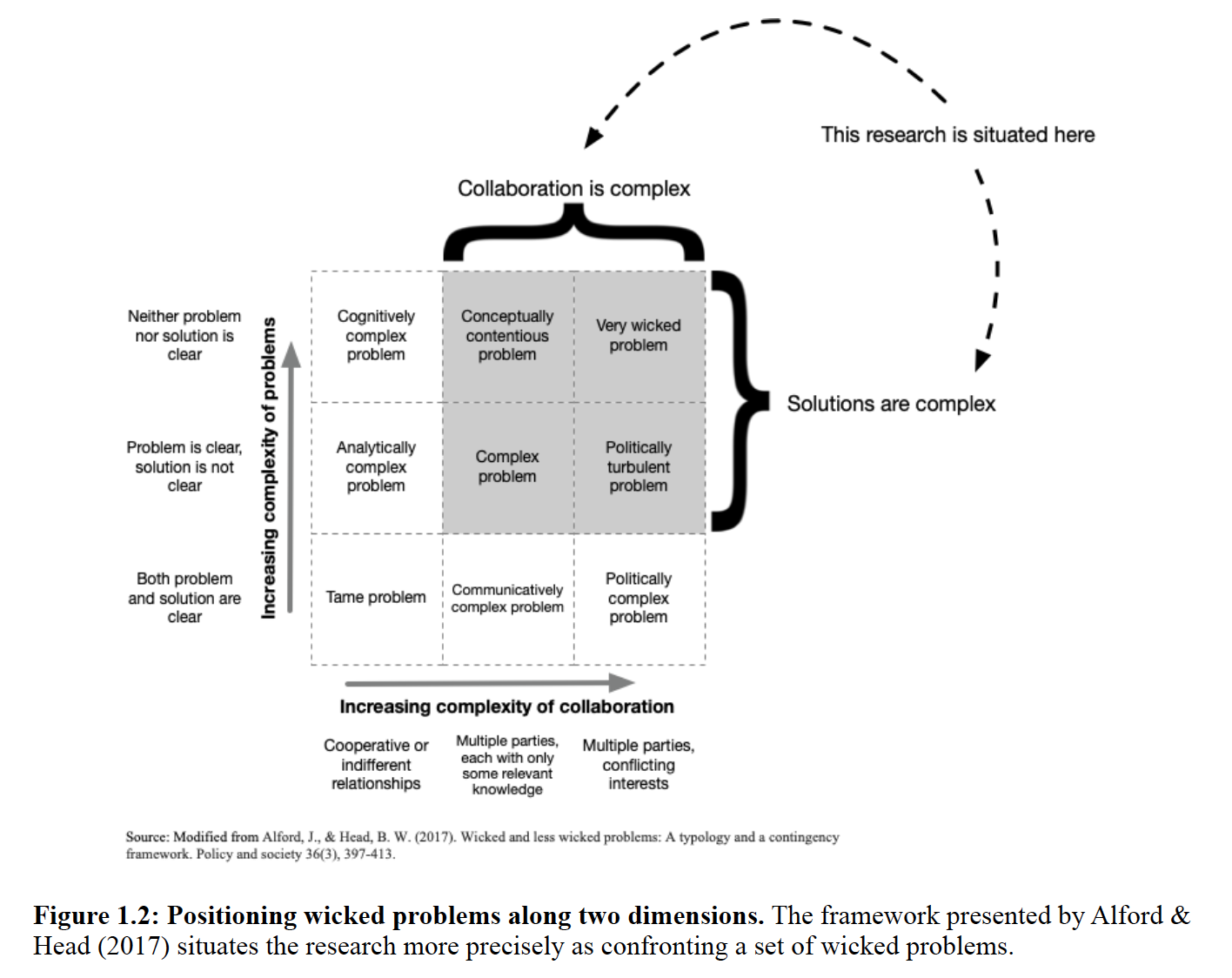
Positioning Wicked Problems Along Two Dimensions
A visual framework helping distinguish problem complexity and collaboration intensity.
Why good leaders make you feel safe
Explores how trust, care, and psychological safety enable learning, performance, and long-term organisational resilience.
Psychological Safety
Explains why trust and inquiry are essential for effective teamwork and learning.
Levels of Appreciative Inquiry
Uses experiences from COVID-era collaboration to illustrate how inquiry operates across multiple system levels.
Psychological Safety: A Meta-Analytic Review and Extension
A comprehensive review showing how psychological safety affects learning, performance, and collaboration.
The Essentials of Appreciative Inquiry
Examines how carefully crafted questions shape attention, behaviour, and outcomes in organisations and communities.
Simple Rules, Complex Behavior
Explains how simple guiding rules enable complex, adaptive behaviour.
Collaborative Networks: a mechanism for enterprise agility and resilience
A scholarly paper explaining why collaborative networks outperform hierarchical structures in volatile environments, providing theoretical grounding for Strategic Doing’s network-based approach.
Teams Solve Problems Faster When They’re More Cognitively Diverse
Demonstrates the performance benefits of cognitive diversity when collaboration is intentionally designed.
A visual example of the problem with vision statements
A TED talk that uses humour and design failures to show why poorly framed vision statements confuse rather than align, reinforcing the importance of clarity and shared meaning.
An Effectual Model of Collective Action for Addressing Sustainability Challenges
Presents a model for collective action under uncertainty, integrating effectuation theory with Strategic Doing.
Distributed Leadership as a Sustainable and Inclusive Leadership Approach
Provides a framework for understanding leadership as a shared, relational practice.
Allowing Change Through “Letting It Happen”
Explores how enabling conditions and restraint often lead to more durable change.
Key themes: Emergence, complexity, indirect actionBuilding a Culture that Stimulates “Collective Genius”
Explains how diverse perspectives and disciplined collaboration enable innovation rather than reliance on individual brilliance.